EU CBAM Annual Declaration 2027

Updated: Jul 30
The Executive Compliance Playbook for Authorised CBAM Declarants
Preparing, Verifying and Filing the First Annual CBAM Declaration for 2026 Imports Before the 30 September 2027 Statutory Deadline
Scope & Disclaimer:
This report is produced for informational purposes only. It does not constitute legal, financial, investment, engineering, or safety-certification advice. Nothing in this report should be relied upon as the sole basis for compliance decisions. CBAM Journal does not endorse any named company or product. Company-attributed figures are sourced from the cited documents and are presented as such. Readers should seek independent professional advice appropriate to their circumstances.
For full terms, see the Disclaimer and Terms page at cbamjournal.com.

1. Executive Summary
The First Legally Binding EU CBAM Declaration
FINDING: Article 6(1) of Regulation (EU) 2023/956 requires every authorised CBAM declarant to submit the first annual declaration for 2026 imports by 30 September 2027 via the CBAM Registry, surrendering the corresponding CBAM certificates at the same deadline.
SO WHAT: The transition from informational quarterly reporting to legally enforceable annual compliance means organisations now face direct financial liability — at the current EU ETS carbon price of approximately €84 per tonne CO₂ (July 2026), a single tonne of imported steel carrying approximately 2.0 tCO₂ of embedded emissions generates a CBAM certificate cost of roughly €168 per tonne.
NOW WHAT: Establish a formal CBAM implementation programme covering governance, supplier engagement, emissions verification, and Registry readiness, with the implementation clock treated as running from 1 January 2026, not from the filing deadline.
Beginning 1 January 2026, the EU entered the definitive phase of the Carbon Border Adjustment Mechanism. The transitional reporting period that ran from 1 October 2023 to 31 December 2025 — under which importers submitted quarterly emissions reports with no financial obligation — has ended. Every import of a covered good into the EU from 2026 onward triggers a real financial liability denominated in CBAM certificates priced at the EU Emissions Trading System (ETS) rate.
The first EU CBAM Annual Declaration covers all in-scope imports made during the 2026 calendar year. It must be submitted, and the corresponding CBAM certificates surrendered, by 30 September 2027. This is a statutory legal obligation under Article 6 of Regulation (EU) 2023/956, with enforcement consequences under Article 26 for failure.
For organisations importing steel, aluminium, cement, fertilisers, hydrogen, or electricity into the EU, the financial exposure is sector-specific and material. Primary aluminium, at approximately 14 tCO₂ per tonne, generates a certificate obligation of approximately €1,176 per tonne at the July 2026 EU ETS price. Grey hydrogen carries approximately 12.5 tCO₂ per tonne, producing a certificate cost of approximately €1,050 per tonne. These obligations apply to goods imported from 1 January 2026.
What Compliance Managers Must Deliver
FINDING: Article 6(2) of Regulation (EU) 2023/956 specifies that the annual declaration must contain: total quantities of each covered good imported, embedded CO₂ emissions in tonnes per unit, the number of CBAM certificates to be surrendered (adjusted for any carbon-price relief under Article 9 and free-allocation adjustments under Article 31), and copies of accredited verification reports.
SO WHAT: Missing or inaccurate data across any mandatory field may delay submission, trigger corrective action by the competent authority, or expose the authorised declarant to enforcement under Article 26.
NOW WHAT: Create an internal evidence register assigning ownership for every declaration data field — import quantities, emissions data, verification reports, and certificate reconciliation — with completion milestones across Q1 to Q4 2026.
The annual declaration draws on data from customs teams (import quantities and CN codes), sustainability or procurement functions (embedded emissions from third-country producers), external accredited verifiers (verification reports), and finance teams (certificate purchase and surrender). Without formal ownership and a structured evidence register built during 2026, organisations will arrive at the September 2027 deadline with gaps that cannot be closed in time.
Requirement | Data Source | Internal Owner | Required? |
Import quantities (by CN code) | Customs declarations | Customs / Trade | ✔ |
Embedded CO₂ emissions (tCO₂e per unit) | Third-country producer | Sustainability | ✔ |
Carbon-price adjustments (Art 9) | Supplier documentation | Finance / Compliance | ✔ |
Number of CBAM certificates to surrender | Calculated from emissions | Finance | ✔ |
Accredited verification reports | Accredited verifier | Compliance | ✔ |
CBAM Registry submission | Registry system | Compliance Manager | ✔ |
Why Existing Guidance Is Not Enough
FINDING: The European Commission published updated CBAM FAQs on 27 May 2026 and a factsheet on actual versus default values on 23 June 2026, but neither document provides an end-to-end corporate implementation methodology, a governance framework, or an evidence management structure for compliance teams.
SO WHAT: Compliance Managers who rely solely on Commission guidance must independently translate legislative obligations into operational workflows across customs, procurement, sustainability, finance, and legal functions — a translation that no public document currently performs.
NOW WHAT: Use this report as the organisation's primary implementation manual for the 30 September 2027 filing, supplementing rather than replacing direct reference to Regulation (EU) 2023/956 and Commission guidance.
What Free Public Guidance Provides | What This Report Provides |
Explains legal obligations | Explains operational implementation |
Describes what must be declared | Specifies how to gather, validate, and submit each data field |
Identifies relevant Articles | Translates Articles into internal workflows and ownership structures |
Lists sector scope | Analyses sector-specific compliance friction and risk |
No governance model | RACI matrix and evidence management framework |
Key Executive Takeaways
FINDING: The Commission's Q2 2026 CBAM certificate price was made available on 6 July 2026, and the Q1 2026 price was first published on 7 April 2026 — confirming that the definitive regime is operational and financial obligations are accruing in real time.
SO WHAT: Organisations that delay supplier engagement, verification commissioning, or Registry preparation risk arriving at 30 September 2027 unable to file a complete, verified declaration, with financial penalties under Article 26 and a continuing surrender obligation as the consequence.
NOW WHAT: Treat the five strategic conclusions below as non-negotiable starting points for board-level briefing and develop a 2026–2027 implementation roadmap with defined milestones by end of Q1 2026.
Five strategic conclusions from this report:
1. The first annual declaration is a statutory compliance obligation, not a reporting exercise. Failure carries financial penalties under Article 26 plus a continuing certificate surrender requirement.
2. Supplier emissions data is a strategic compliance asset. Without verified data from third-country producers, organisations must rely on default values — and default value mark-ups under Implementing Regulation (EU) 2025/2621 increase from +10% in 2026 to +20% in 2027 to +30% from 2028 for most sectors. Fertilisers carry a separate lower mark-up of +1% under the same instrument.
3. Governance failures create greater compliance risk than technical calculation errors. Most first-year failures will originate from unclear ownership, not from misreading the methodology.
4. Registry readiness cannot be deferred to 2027. CBAM certificate sales begin 1 February 2027; declarant status confirmation and access testing must happen during 2026.
5. The financial exposure is sector-specific. Aluminium and hydrogen importers face the highest per-unit certificate costs; steel importers face the highest aggregate exposure by volume.
2. Regulatory Context
The Legal Foundation of the EU CBAM
FINDING: Regulation (EU) 2023/956, as amended by Regulation (EU) 2025/2083 (in force October 2025), is the primary legal instrument governing the EU CBAM Annual Declaration: Article 6 governs declaration requirements, Article 7 governs embedded emissions calculation, Article 8 governs verification, Article 9 governs carbon-price adjustments, Article 22 governs certificate holding requirements, and Article 31 governs free-allocation deductions.
SO WHAT: The annual declaration is a statutory legal obligation under primary EU law — not an administrative reporting exercise — meaning that errors, omissions, or missed deadlines expose the authorised CBAM declarant to enforcement powers exercised by the relevant national competent authority.
NOW WHAT: Map every declaration data field to its governing Article before building internal processes, and ensure the compliance team has direct access to the consolidated text of Regulation (EU) 2023/956 as amended by end of Q1 2026.
Legal Instrument | Governing Article / Provision | Compliance Obligation |
Regulation (EU) 2023/956 | Article 5 | Authorised CBAM declarant status requirement |
Regulation (EU) 2023/956 | Article 6(1) | Annual declaration submission by 30 September |
Regulation (EU) 2023/956 | Article 6(2) | Mandatory declaration content (quantities, emissions, certificates, verification) |
Regulation (EU) 2023/956 | Article 7 | Embedded emissions calculation methodology |
Regulation (EU) 2023/956 | Article 8 | Verification requirements for embedded emissions |
Regulation (EU) 2023/956 | Article 9 | Carbon-price adjustment for third-country charges |
Regulation (EU) 2023/956 | Article 22 | Quarterly certificate holding (minimum 50% of cumulative embedded emissions) |
Regulation (EU) 2023/956 | Article 26 | Penalty for failure to surrender certificates |
Regulation (EU) 2023/956 | Article 31 | Free-allocation deduction from certificate requirement |
Regulation (EU) 2023/956, Annex I | CN codes | Covered sectors and product scope |
From Transitional Reporting to Definitive Compliance
FINDING: The EU CBAM transitional period ran from 1 October 2023 to 31 December 2025, requiring only quarterly emissions reporting with no certificate purchase obligation; the definitive regime commenced on 1 January 2026, introducing legally binding annual declarations and financial liability, with CBAM certificate sales opening from 1 February 2027.
SO WHAT: Organisations operating internal processes built for the transitional period — quarterly data collection, informal supplier engagement, no certificate management — are structurally unfit for definitive compliance and face high risk of data gaps in the 2026 declaration dataset.
NOW WHAT: Audit and replace transitional CBAM processes with a permanent annual compliance framework before end of Q2 2026, covering data governance, supplier contracts, verification scheduling, and Registry access.
Period | Regime | Obligations | Financial Liability |
1 Oct 2023 – 31 Dec 2025 | Transitional | Quarterly emissions reports | None |
1 Jan 2026 onward | Definitive | Annual declaration + certificate surrender | Yes — EU ETS price (≈€84/tCO₂, Jul 2026) |
1 Feb 2027 | Certificate sales open | CBAM certificate purchases begin via central platform | Certificates priced at 2026 average EU ETS price |
By 30 Sep 2027 | First annual filing | Declaration for full 2026 import year + certificate surrender | Certificate surrender required |
Who Must File the Annual Declaration?
FINDING: Only an authorised CBAM declarant registered in the CBAM Registry may submit the annual CBAM declaration; the importer of record is not automatically the authorised declarant, and a customs representative may handle customs paperwork without bearing declarant responsibility for the annual filing.
SO WHAT: Confusion over who holds declarant status — and who therefore bears legal responsibility for the annual declaration — creates risk of unregistered financial liability and potential non-compliance with Article 6.
NOW WHAT: Confirm authorised declarant status in the CBAM Registry and formally document the organisational role responsible for annual filing before 1 July 2026.
Party | Role in CBAM Filing | Legal Responsibility for Declaration |
Authorised CBAM Declarant | Files the annual declaration | Full legal responsibility under Article 6 |
Importer of record | May or may not be the declarant | Only if also the authorised declarant |
Customs broker / representative | Handles customs declarations | No — customs role only |
Third-country producer | Supplies embedded emissions data | No — data provider only |
Accredited verifier | Independently verifies emissions | No — assurance role only |
Scope of Goods Covered
FINDING: Annex I to Regulation (EU) 2023/956 defines the CBAM-covered sectors by CN code: iron and steel (CN 72), aluminium (CN 76), cement (CN 2523), fertilisers (CN 3102/3105), hydrogen (CN 2804 10), and electricity (CN 2716) — six sectors in total under the EU definitive regime.
SO WHAT: Importing goods under a CN code not listed in Annex I carries no CBAM obligation; importing goods under a covered CN code without completing the annual declaration carries full enforcement exposure regardless of import value, above the 50-tonne annual threshold.
NOW WHAT: Validate all imported product CN codes against Annex I before end of Q1 2026 and implement a classification control to flag any new CBAM-covered imports throughout the reporting year.
Sector | CN Code Range | EU CBAM (Definitive) | UK CBAM (from 2027) |
Iron & Steel | CN 72 | ✔ | ✔ |
Aluminium | CN 76 | ✔ | ✔ |
Cement | CN 2523 | ✔ | ✔ |
Fertilisers (nitrogenous) | CN 3102 / 3105 | ✔ | ✔ |
Hydrogen | CN 2804 10 | ✔ | ✔ |
Electricity | CN 2716 | ✔ | ✗ — excluded from UK CBAM |
How the EU Regime Differs from UK CBAM
FINDING: The EU CBAM definitive regime commenced 1 January 2026 with a first annual declaration due 30 September 2027; the UK CBAM, established under Finance Act 2026 (Schedule 16) and administered by HMRC, commences 1 January 2027 with the first annual return due 31 May 2028 — a different legal instrument, different threshold, different deadline, and different product scope.
SO WHAT: Multinational organisations importing into both the EU and UK must maintain separate compliance processes: conflating EU and UK obligations risks misreporting under both, as the thresholds, deadlines, covered sectors, and enforcement mechanisms differ materially.
NOW WHAT: Develop separate EU CBAM and UK CBAM compliance procedures, with shared governance oversight, and document the differences in product scope — especially electricity — before end of Q3 2026.
Topic | EU CBAM | UK CBAM |
Legal basis | Regulation (EU) 2023/956 | Finance Act 2026, Schedule 16 |
Administering authority | National competent authorities / CBAM Registry | HMRC |
Definitive regime start | 1 January 2026 | 1 January 2027 |
Import threshold | 50 tonnes per year per importer | £50,000 import value per year |
First return / declaration deadline | 30 September 2027 (for 2026 imports) | 31 May 2028 (for 2027 imports) |
Electricity covered? | Yes | No |
Hydrogen covered? | Yes | Yes |
Subsequent returns | Annual, by 30 September each year | Quarterly from Q1 2028 onward |
3. Compliance Obligations
Who Is Legally Responsible for Filing?
FINDING: Regulation (EU) 2023/956 (Article 5) requires only an authorised CBAM declarant to submit the annual CBAM declaration through the CBAM Registry; the authorised CBAM declarant bears full legal responsibility for the completeness and accuracy of the declaration — this responsibility cannot be transferred by any delegation or outsourcing arrangement.
SO WHAT: Delegating the filing process to a third party — a customs agent, tax adviser, or shared-service centre — does not transfer legal liability; if the declaration is incorrect or incomplete, enforcement action falls on the authorised CBAM declarant.
NOW WHAT: Document the identity of the authorised CBAM declarant in writing, record any operational assistance arrangements with explicit scope limitations, and retain this documentation in the compliance evidence register before 1 July 2026.
Organisation | Responsibility in CBAM Process | Retains Legal Liability? |
Authorised CBAM Declarant | Annual declaration submission and certificate surrender | Yes — full legal responsibility under Article 5 |
Importer of record | Commercial responsibility for goods | Only if also the authorised declarant |
Customs broker | Customs declaration (SAD) filing | No |
Third-country producer | Emissions data supply and verification cooperation | No |
Accredited verifier | Independent emissions assurance | No |
The legal structure of Article 5 is widely misread. Many organisations assume outsourcing the filing process transfers the compliance obligation. It does not. The authorised CBAM declarant is the entity registered in the CBAM Registry. It is the entity the national competent authority will pursue in the event of enforcement. Compliance governance must reflect this reality: the Compliance Manager's role is to own the declaration outcome, not merely to administer the filing.
What Information Must Be Included in the Annual Declaration?
FINDING: Article 6(2) of Regulation (EU) 2023/956 requires the annual declaration to contain: total imported quantities per covered good, embedded CO₂ emissions in tonnes CO₂e per unit, the number of CBAM certificates to be surrendered after applying carbon-price adjustments under Article 9 and free-allocation deductions under Article 31, and copies of accredited verification reports where actual emissions values are used.
SO WHAT: Every declaration data field must be supported by traceable documentary evidence in the compliance evidence register; a declaration filed without complete supporting documentation cannot withstand a competent authority audit and may be treated as incomplete.
NOW WHAT: Build the declaration data register by end of Q1 2026, mapping each Article 6(2) field to its source system, internal owner, and supporting documentation type, with milestone reviews each quarter throughout 2026.
Declaration Field (Article 6(2)) | Source System / Document | Internal Owner | Documentation Required |
Total imported quantity per good (tonnes) | Customs declaration (SAD) | Customs / Trade | Customs entries by CN code |
CN code / product classification | ERP / trade management system | Procurement / Trade | Classification records |
Embedded CO₂ emissions (tCO₂e per unit) | Third-country producer or default values | Sustainability | Producer emissions report or Commission default value table |
Carbon-price adjustment (Art 9) | Supplier invoices / carbon price evidence | Finance / Compliance | Proof of carbon charges paid in country of origin |
Free-allocation adjustment (Art 31) | EU registry data | Compliance | Free allocation records (where applicable) |
Number of certificates to surrender | Calculated from emissions after adjustments | Finance | Certificate calculation workbook |
Verification reports | Accredited verifier | Compliance | Signed verification reports from accredited body |
Embedded Emissions Verification Requirements
FINDING: Article 8 of Regulation (EU) 2023/956 requires that where actual embedded emissions are reported in the annual declaration, those emissions must be verified by an accredited verifier; the Commission's 23 June 2026 factsheet on actual versus default values confirms that importers may alternatively use permitted default values where actual data is unavailable, subject to the applicable mark-up schedule under Implementing Regulation (EU) 2025/2621.
SO WHAT: Verification is the highest-friction element of the first annual declaration: it requires the third-country producer to cooperate, the verifier to be accredited and available, and the verification report to be complete before the 30 September 2027 submission deadline — a process that cannot be compressed into the final weeks before filing.
NOW WHAT: Identify accredited verifiers and initiate producer engagement for emissions data collection no later than Q2 2026, allowing sufficient lead time for the verification process before the 30 September 2027 deadline.
Organisations that cannot obtain actual verified emissions data from third-country producers may use Commission default values. Default values carry a mark-up above actual emission intensities under Implementing Regulation (EU) 2025/2621: +10% in 2026, +20% in 2027, and +30% from 2028 onward for steel, aluminium, cement, and hydrogen.
Fertilisers carry a lower mark-up of +1%. The incentive to invest in supplier engagement and verification is direct and quantifiable: every year that organisations rely on defaults rather than actual data, the certificate obligation increases under the escalating mark-up schedule.

The verification workflow requires coordination across three parties:
the third-country producer (who must calculate and provide emissions data),
the accredited verifier (who must independently confirm the producer's calculations),
and the authorised CBAM declarant (who must receive and validate the verification report before submitting the declaration).
Each handoff in this chain carries schedule risk.
CBAM Certificate Obligations
FINDING: Article 22(2) of Regulation (EU) 2023/956 as amended by Regulation (EU) 2025/2083 requires authorised CBAM declarants to hold, from 2027, CBAM certificates equal to at least 50% of the embedded emissions in goods imported since the start of the calendar year at each quarterly review point; the full surrender of certificates corresponding to declared embedded emissions must occur by 30 September each year.
SO WHAT: Poor certificate planning creates a compound financial risk: organisations that purchase certificates reactively rather than forecasting needs quarterly may face both a shortfall at the annual deadline and cash-flow disruption from unplanned purchases at elevated market prices.
NOW WHAT: Coordinate compliance and finance teams to build a certificate forecast model by Q1 2027, updated quarterly against actual import volumes and embedded emissions data, with a minimum 50% coverage ratio maintained at each quarter end.
The certificate obligation is not a single year-end transaction. From 2027, the declarant's certificate balance must cover at least 50% of cumulative embedded emissions at each quarterly check — a standing obligation under Article 22(2) separate from the annual surrender requirement. An organisation that purchases all certificates in September 2027, immediately before the annual deadline, risks a compliance failure at one or more quarterly review points during the year.
The financial planning implication is significant. Certificate costs at approximately €84 per tCO₂ (July 2026) mean that a company importing 10,000 tonnes of steel annually — with embedded emissions of approximately 2.0 tCO₂ per tonne — must budget for approximately €1.68 million in annual certificate costs. The quarterly 50% holding requirement means roughly €840,000 must be committed in certificates before each mid-year review point. Finance teams must model these as standing working capital commitments, not year-end line items.
Note: CBAM certificate sales via the EU's central platform begin on 1 February 2027. Certificates purchased in 2027 for 2026 imports will be priced using the average 2026 EU ETS allowance value.
Internal Governance and Evidence Management
FINDING: Regulation (EU) 2023/956 does not prescribe a corporate governance model for CBAM compliance; the legal responsibility for gathering customs, emissions, verification, and certificate data across multiple business functions rests entirely with the authorised CBAM declarant's internal control framework.
SO WHAT: Where internal ownership is unclear, the risk is not a technical calculation error but a structural data gap that prevents declaration submission — the kind of failure that no amount of last-minute effort can resolve after the 30 September 2027 deadline.
NOW WHAT: Implement a formal RACI matrix, evidence register, and document retention policy covering all CBAM declaration activities before end of Q2 2026, with monthly governance reviews from Q3 2026 through to the submission deadline.
Activity | Compliance | Customs | Procurement | Sustainability | Finance |
Registry access and declarant management | A | C | I | I | I |
Import data collection and CN code validation | C | A | I | I | I |
Embedded emissions data collection | C | I | C | A | I |
Verification commissioning and management | A | I | C | C | I |
Certificate purchase and surrender | C | I | I | I | A |
Annual declaration preparation and submission | A | C | I | C | C |
A = Accountable | C = Consulted | I = Informed
Common Compliance Risks
FINDING: The Commission's verified requirements — actual emissions data from third-country producers, complete declaration information, and corresponding certificate surrender — mean that most first-year compliance failures will originate from operational execution gaps rather than misunderstanding the legislation.
SO WHAT: A single supplier that fails to provide verified emissions data on time, a verification report that arrives after the Registry submission window, or a certificate balance falling below the 50% quarterly threshold each creates a direct compliance failure that cannot be remedied after the deadline has passed.
NOW WHAT: Introduce a monthly compliance readiness review covering supplier data status, verification progress, Registry readiness, and certificate forecasting from Q1 2026 through to submission in September 2027.
Compliance Risk | Probability | Financial / Regulatory Impact | Mitigation |
Supplier delay in providing emissions data | High | High — forces use of higher-cost default values | Formal engagement and contractual data-sharing obligations by Q2 2026 |
Incorrect or unverified emissions figures | Medium | High — inaccurate declaration; enforcement exposure | Independent verification per Article 8; internal review before submission |
Certificate balance below 50% at quarterly review | Medium | High — compliance failure independent of annual deadline | Quarterly forecasting model updated against actual imports |
Registry submission errors or access failure | Medium | Medium — filing delay; enforcement exposure | Registry access testing in H1 2027; pre-submission validation |
CN code misclassification | Medium | Medium — under- or over-reporting | CN code audit against Annex I before end of Q1 2026 |
Missing or incomplete verification report | High (first year) | High — declaration cannot be submitted as compliant | Verification timetable agreed with verifier by Q2 2026 |
4. Key Dates and Compliance Timeline
The CBAM Compliance Timeline: From Transition to Annual Declaration
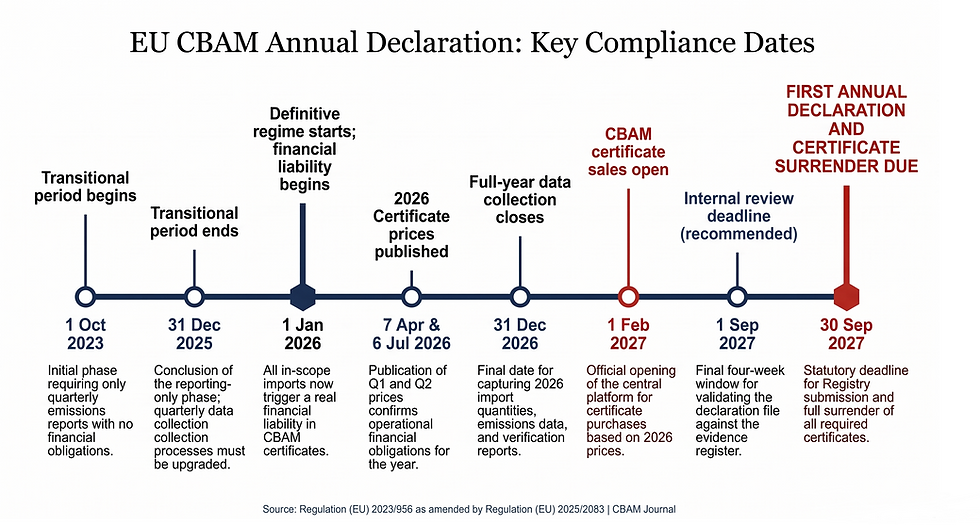
FINDING: Article 6(1) of Regulation (EU) 2023/956 requires authorised CBAM declarants to submit the first annual CBAM declaration for 2026 imports by 30 September 2027 via the CBAM Registry — a deadline that follows a full calendar year of data collection covering every in-scope import from 1 January 2026 to 31 December 2026.
SO WHAT: The compliance window for the first annual declaration began on 1 January 2026, not in 2027: every import made in 2026 must be captured, verified, and evidenced before the September 2027 filing deadline, making the data-gathering year — not the filing month — the critical period.
NOW WHAT: Treat 1 January 2026 as the operational start date of first-year CBAM compliance and implement a structured programme covering the entire 2026 reporting year through to the 30 September 2027 submission.
Date | Milestone | Operational Action Required |
1 Oct 2023 | Transitional period begins | Quarterly emissions reports (no payment) |
31 Dec 2025 | Transitional period ends | Final quarterly report; transition to definitive compliance processes |
1 Jan 2026 | Definitive EU CBAM regime starts | All CBAM-covered imports now financially liable; data collection begins |
7 Apr 2026 | Q1 2026 certificate price published | First certificate cost confirmed; update financial forecasts |
6 Jul 2026 | Q2 2026 certificate price published | Reforecast certificate budget for H2 2026 |
Jan–Dec 2026 | Full reporting year | Collect import data, emissions data, and verification reports for all covered goods |
1 Feb 2027 | CBAM certificate sales open | Certificates purchasable via EU central platform; priced at 2026 average EU ETS value |
30 Sep 2027 | First annual declaration and certificate surrender due | Submit complete declaration via CBAM Registry; surrender all required certificates |
Month-by-Month Compliance Roadmap for 2026
FINDING: The Commission confirmed on 23 June 2026 that importers using actual emissions values must obtain verified emissions data from third-country producers before preparing the annual declaration — a process that requires supplier engagement, data collection, and independent verification well before the 30 September 2027 deadline.
SO WHAT: Compressing supplier engagement, emissions verification, data validation, and Registry preparation into the final months before September 2027 is operationally unachievable for organisations with multiple CBAM-covered suppliers across different countries and sectors.
NOW WHAT: Implement a quarterly supplier reporting cycle with defined milestone reviews: formal data requests by Q2 2026, first data submissions by Q3 2026, verification commissioning by Q3 2026, and final evidence reconciliation by Q4 2026.
Quarter | Key Activities | Owner | Deliverable |
Q1 2026 (Jan–Mar) | Confirm authorised declarant status; CN code audit against Annex I; governance RACI agreed; evidence register built | Compliance lead | Governance framework; evidence register v1 |
Q1 2026 (Jan–Mar) | Identify CBAM-covered suppliers; issue formal data request letters for embedded emissions | Procurement / Sustainability | Supplier list; data request letters sent |
Q2 2026 (Apr–Jun) | Collect Q1 2026 import data from customs; obtain first supplier data returns; identify verification provider | Customs; Compliance | Q1 import dataset; verifier contract signed |
Q3 2026 (Jul–Sep) | Collect Q2 and Q3 import data; receive supplier emissions data; commission verification | Sustainability; Compliance | Supplier emissions dataset (partial); verification in progress |
Q4 2026 (Oct–Dec) | Final import data reconciliation; receive all supplier emissions data; finalise verification reports; build declaration file | All functions | Complete evidence file; draft declaration ready |
Q1–Q2 2027 (Jan–Jun) | Internal review of declaration file; Registry testing; certificate balance management | Compliance; Finance | Validated declaration; certificate position confirmed |
Q3 2027 (Jul–Sep) | Final declaration validation; Registry submission; certificate surrender by 30 September 2027 | Compliance; Finance | Submitted declaration; certificates surrendered |
The 30 September 2027 Deadline Explained
FINDING: By 30 September 2027, authorised CBAM declarants must both submit the annual declaration and surrender the corresponding CBAM certificates through the CBAM Registry — two simultaneous obligations, meaning a certificate shortfall on the deadline date constitutes non-compliance even if the declaration text is complete.
SO WHAT: Organisations that complete the declaration but fail to surrender the full certificate quantity by 30 September 2027 face the Article 26 penalty — approximately €100 per excess tonne — plus the continuing obligation to acquire and surrender the outstanding certificates.
NOW WHAT: Begin final declaration validation and certificate reconciliation no later than 1 August 2027, allowing a minimum six-week window for Registry submission, error resolution, and certificate surrender before the 30 September 2027 hard deadline.
Deliverable Required by 30 September 2027 | Description | Status if Missing |
Annual CBAM declaration submitted | Full declaration via CBAM Registry covering all 2026 imports | Non-compliance; enforcement exposure |
Embedded emissions reported | Total tCO₂e per good, per Article 6(2) | Incomplete declaration |
Verification reports attached | Accredited verifier reports for actual emissions | Declaration not accepted as verified |
Carbon-price adjustments applied | Article 9 reductions based on third-country carbon charges | Certificate over-surrender without reduction |
CBAM certificates surrendered | Full quantity corresponding to declared net emissions | Article 26 penalty + continuing surrender obligation |
Quarterly Certificate Management Requirements
FINDING: Article 22(2) of Regulation (EU) 2023/956 (as amended by Regulation (EU) 2025/2083) requires authorised CBAM declarants to hold, from 2027, CBAM certificates equal to at least 50% of the embedded emissions in goods imported since the start of the calendar year at each quarterly review point — a standing obligation separate from the annual surrender requirement.
SO WHAT: An organisation that manages certificates only at the annual deadline, rather than maintaining the 50% quarterly balance, risks a compliance failure at the quarterly review point even if the annual declaration is ultimately submitted on time.
NOW WHAT: Introduce quarterly certificate reconciliation between customs import volumes, embedded emissions forecasts, and certificate holdings, with a minimum 50% coverage ratio reviewed at the end of each quarter from Q1 2027.
Quarter (2027) | Review Activity | Minimum Certificate Balance Required |
Q1 2027 (end of March) | Compare cumulative imports (Jan–Mar) vs certificates held | 50% of Q1 embedded emissions |
Q2 2027 (end of June) | Compare cumulative imports (Jan–Jun) vs certificates held | 50% of Jan–Jun embedded emissions |
Q3 2027 (end of September) | Final annual deadline — full surrender required by 30 Sep | 100% of full-year 2026 embedded emissions |
Q4 2027 (end of December) | Quarterly balance for 2027 reporting year | 50% of Jan–Dec 2027 cumulative embedded emissions |
EU and UK CBAM Timeline Comparison
FINDING: The EU CBAM definitive regime started 1 January 2026 with the first annual declaration due 30 September 2027; the UK CBAM starts 1 January 2027 under Finance Act 2026 (Schedule 16), with the first annual return due 31 May 2028, after which UK returns become quarterly from Q1 2028.
SO WHAT: Organisations that assume EU and UK CBAM timelines are aligned will build a single compliance calendar that misses the UK's five-month offset from calendar year-end — a governance error with direct enforcement consequences.
NOW WHAT: Maintain separate compliance calendars for EU CBAM and UK CBAM under a unified governance framework, anchored to 30 September annually for EU and 31 May 2028 for the first UK return, with quarterly filings thereafter.
Topic | EU CBAM | UK CBAM |
Definitive regime start | 1 January 2026 | 1 January 2027 |
First reporting year | 2026 (full calendar year) | 2027 (full calendar year) |
First declaration / return deadline | 30 September 2027 | 31 May 2028 |
Subsequent filing frequency | Annual (30 September each year) | Quarterly from Q1 2028 onward |
Certificate / payment obligation | CBAM certificates via Registry (sales from 1 Feb 2027) | UK carbon levy via HMRC tax return |
5. Financial Exposure and Risk
Understanding the Financial Impact of the Annual Declaration
FINDING: CBAM certificates are priced at the EU ETS carbon price; as of July 2026, the EU ETS price is approximately €84 per tonne CO₂, meaning every tonne of embedded CO₂ in a covered import generates a certificate cost of €84, with total cost determined by import volume multiplied by embedded CO₂ intensity.
SO WHAT: The annual declaration directly determines the number of certificates to be surrendered after carbon-price adjustments — making the accuracy of embedded emissions data a direct financial variable, not merely a reporting requirement.
NOW WHAT: Integrate CBAM certificate forecasting into annual budgeting and import planning for 2026, using a working assumption of €84 per tCO₂ and updating quarterly as the Commission publishes new certificate prices.
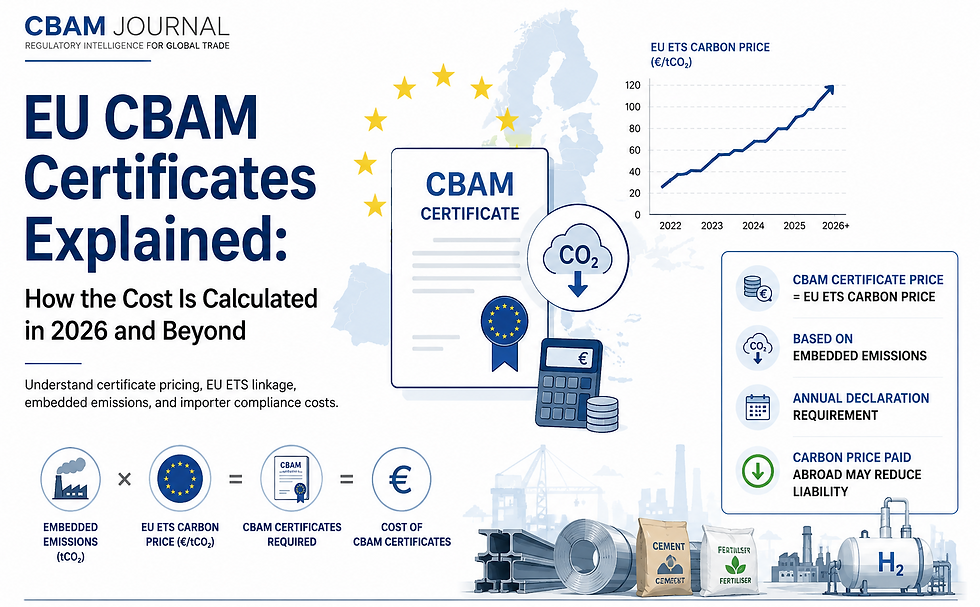
The financial mechanics of EU CBAM are straightforward in structure but significant in scale. The declaration reports embedded emissions. Those emissions, after any adjustments for carbon prices paid in the country of origin (Article 9) and for free allocations under the EU ETS (Article 31), determine the number of certificates to surrender. Each certificate costs the EU ETS price on purchase. The financial exposure is therefore: Import volume (tonnes) × Embedded CO₂ intensity (tCO₂/tonne) × EU ETS price (€/tCO₂) — adjusted for any third-country carbon price relief.
CBAM Certificate Cost Exposure by Sector
FINDING: At the July 2026 EU ETS price of approximately €84 per tonne CO₂: imported steel (approximately 2.0 tCO₂/tonne) carries a CBAM cost of approximately €168 per tonne; primary aluminium (approximately 14 tCO₂/tonne) carries approximately €1,176 per tonne; fertilisers such as urea (approximately 1.6 tCO₂/tonne) carry approximately €134 per tonne; and grey hydrogen (approximately 12.5 tCO₂/tonne) carries approximately €1,050 per tonne.
SO WHAT: The disparity in per-unit certificate costs across sectors means organisations importing multiple CBAM-covered commodities must maintain separate financial models and certificate forecasts for each product type — a single blended forecast will systematically misprice exposure.
NOW WHAT: Develop rolling sector-by-sector certificate forecasts updated as verified emissions data becomes available from producers, using the quarterly Commission certificate prices as the pricing input from Q1 2027.

Sector | Approx. Embedded CO₂ (tCO₂/unit) | CBAM Cost at €84/tCO₂ (Jul 2026) | Illustrative Annual Exposure (10,000t import) |
Iron & Steel | ≈2.0 tCO₂/tonne | ≈€168/tonne | ≈€1.68 million |
Primary Aluminium | ≈14 tCO₂/tonne | ≈€1,176/tonne | ≈€11.76 million |
Cement | ≈0.7–0.9 tCO₂/tonne (indicative) | ≈€59–76/tonne (indicative) | ≈€590,000–760,000 (indicative) |
Fertilisers (urea) | ≈1.6 tCO₂/tonne | ≈€134/tonne | ≈€1.34 million |
Hydrogen (grey) | ≈12.5 tCO₂/tonne | ≈€1,050/tonne | ≈€10.5 million |
Electricity | ≈0.28 tCO₂/MWh (indicative — country-specific) | ≈€23.5/MWh (indicative) | N/A — volume dependent |
Note: Embedded CO₂ figures are indicative estimates based on sector research data and must not be used as official defaults. Organisations must use either verified actual emissions data or the Commission's published default values under Implementing Regulation (EU) 2025/2621 for the specific goods and countries of origin. Cement and electricity intensities carry additional uncertainty and should be verified against Commission default value tables before any financial planning. All financial exposures above are illustrative, calculated at the July 2026 EU ETS price of €84/tCO₂.
Penalties for Non-Compliance
FINDING: Article 26 of Regulation (EU) 2023/956 provides that an authorised CBAM declarant who fails to surrender the required number of CBAM certificates by the annual deadline is liable for a penalty equivalent to the EU ETS excess emissions penalty — approximately €100 per excess tonne CO₂ — and payment of this penalty does not extinguish the obligation to acquire and surrender the outstanding certificates.
SO WHAT: The dual-liability structure of Article 26 means that a compliance failure at the annual deadline creates a compounding financial exposure: the declarant pays the penalty and must still purchase and surrender the certificates, effectively paying twice for the shortfall.
NOW WHAT: Establish a quarterly compliance review to monitor certificate balances, declaration readiness, and emerging risks throughout 2026 and 2027 — with a hard internal target of certificate surrender completion by 15 September 2027, two weeks before the statutory deadline.
Article 26 is the provision that most free public guidance fails to explain precisely. The penalty does not discharge the surrender obligation. An organisation that misses the 30 September 2027 deadline, pays the Article 26 penalty, and considers the matter closed remains in non-compliance until the outstanding certificates are surrendered. The national competent authority retains the right to pursue both the penalty and the surrender.
To illustrate scale: Tata Steel (India) accounted for approximately 11.43% of India's 2022 steel exports to the EU. A comparable EU importer of Indian steel at 2.0 tCO₂/tonne and €84/tCO₂ faces approximately €168 per tonne in CBAM certificate costs. At material import volumes, this is a budget line requiring proactive financial governance, not year-end reconciliation.
Supplier and Verification Risk
FINDING: Where actual embedded emissions are reported, the Commission confirms third-country producers must provide verified emissions data; organisations that cannot obtain verified data may use permitted default values under Implementing Regulation (EU) 2025/2621, but those defaults carry mark-ups of +10% in 2026, +20% in 2027, and +30% from 2028 onward for steel, aluminium, cement, and hydrogen (fertilisers: +1%).
SO WHAT: Every year of reliance on default values rather than actual verified data increases the certificate obligation under the escalating mark-up schedule — a compounding financial cost that is entirely avoidable with adequate supplier engagement.
NOW WHAT: Introduce formal supplier readiness assessments and contractual emissions data-sharing obligations for all CBAM-covered suppliers during Q1–Q2 2026, with escalation procedures for suppliers unable to provide verified data by Q3 2026.
Risk | Probability | Financial Impact | Mitigation |
Supplier unable to provide verified emissions data | High (first year) | High — default values with escalating mark-up increase certificate costs | Contractual data-sharing; engagement initiated Q1 2026 |
Verification report delayed past filing deadline | Medium | High — declaration cannot be submitted as verified | Verification timetable agreed with verifier by Q2 2026 |
Incorrect emissions calculation by producer | Medium | High — inaccurate declaration; enforcement risk | Require independent verification per Article 8 |
Late submission of carbon-price adjustment evidence | Medium | Medium — missed Article 9 relief increases surrender requirement | Request carbon pricing documentation alongside emissions data |
Building a Financial Governance Framework
FINDING: The Regulation places legal responsibility on the authorised CBAM declarant but requires accurate import data, embedded emissions, verification reports, and certificate documentation from customs, sustainability, procurement, finance, and compliance functions — data streams across five internal business functions that must converge in a single coherent declaration file.
SO WHAT: Without an integrated financial governance framework, the risk is not a single failed calculation but a cascade of disconnected data quality failures across functions that collectively prevent a verified, complete declaration from being submitted by the statutory deadline.
NOW WHAT: Create a cross-functional CBAM steering committee with monthly reporting on certificate forecasts, supplier readiness, and declaration progress, meeting from Q1 2026 through to submission in September 2027.
Business Function | CBAM Financial Responsibility | Key Deliverable |
Finance | Certificate budget, purchase, quarterly balance management, surrender | Certificate forecast model; purchase records; surrender confirmation |
Compliance | Declaration ownership, Registry management, annual submission | Complete declaration file; Registry submission record |
Customs / Trade | Import data accuracy, CN code validation | Import data by CN code; customs entry reconciliation |
Sustainability | Embedded emissions data collection and producer management | Supplier emissions dataset; verification coordination |
Internal Audit | Independent assurance over CBAM data and controls | Annual CBAM controls review |
6. Sector-Specific Impact Analysis
Iron and Steel: The Highest Compliance Priority by Volume
FINDING: Steel imports under CN 72 carry an estimated embedded emissions intensity of approximately 2.0 tCO₂ per tonne, generating a CBAM certificate cost of approximately €168 per tonne at the July 2026 EU ETS price of €84/tCO₂; at a scale of 10,000 tonnes of annual imports, the total certificate obligation is approximately €1.68 million.
SO WHAT: Steel represents the highest aggregate CBAM exposure by import volume for most EU-facing compliance programmes because of the combination of large traded volumes, varied production routes, and complex embedded emissions profiles that differ significantly by country of origin and production methodology.
NOW WHAT: Prioritise steel suppliers for emissions data collection and accredited verification during Q1–Q2 2026, and validate all steel CN codes against Annex I before beginning data collection.
Embedded emissions profiles differ materially by production route and country of origin. The declaration must reflect the actual production methodology of the specific third-country producer, not a sector average. The emissions figure used in the declaration must come from the producer's own verified data or, where unavailable, from the applicable Commission default value table under Implementing Regulation (EU) 2025/2621 for that specific country and production route.
Compliance Requirement | Steel-Specific Consideration | Priority |
CN code validation | Multiple CN codes under heading 72; verify full product list against Annex I | High |
Producer emissions data | Must reflect specific production route and facility | High |
Accredited verification | Complex emissions profile requires experienced verifier | High |
Customs reconciliation | High import volumes; intensive data reconciliation | High |
Certificate forecast | Large volumes mean small per-tonne errors have large financial consequences | High |
Aluminium: Managing Exceptionally High Carbon Intensity
FINDING: Primary aluminium imports under CN 76 carry an estimated embedded emissions intensity of approximately 14 tCO₂ per tonne (range: 13–15 tCO₂/tonne), generating a CBAM certificate cost of approximately €1,176 per tonne at the July 2026 EU ETS price — the highest per-unit certificate cost of any CBAM-covered sector.
SO WHAT: A 42% decline in Indian unwrought aluminium shipments to the EU — from approximately 18,654 tonnes in January 2025 to approximately 10,875 tonnes in January 2026 — demonstrates that CBAM-driven supply chain disruption in aluminium is already reshaping trade flows and may affect the declarant's supplier base during the reporting year.
NOW WHAT: Engage aluminium producers during Q1 2026 to confirm whether their production is primary or secondary, establish the embedded emissions intensity for the specific goods being imported, and validate the scope of emissions covered under the definitive regime for your specific product classifications.
EU CBAM declarations for aluminium cover direct embedded emissions. Secondary (recycled) aluminium typically carries substantially lower embedded emissions than primary smelting — though the specific figure must be confirmed from the producer's own verified data or the applicable Commission default value. Compliance teams should verify the precise scope of emissions covered for their specific aluminium product classifications with reference to the implementing regulations.
Topic | Primary Aluminium | Secondary (Recycled) Aluminium |
Approximate CO₂ intensity | ≈13–15 tCO₂/tonne | Materially lower — verify from producer data |
Certificate cost at €84/tCO₂ | ≈€1,092–1,260/tonne | Materially lower |
Verification complexity | High | Medium |
Supplier engagement priority | Q1 2026 — critical | Q1–Q2 2026 — high |
Cement: Verification Before Filing
FINDING: Cement imports under CN 2523 carry an estimated embedded emissions intensity of approximately 0.7–0.9 tCO₂ per tonne (indicative — no authoritative Commission default confirmed at time of publication), generating an estimated CBAM certificate cost of approximately €59–76 per tonne at the July 2026 EU ETS price; consult the Commission's published default value tables under Implementing Regulation (EU) 2025/2621 for the applicable figure for the specific product and country of origin.
SO WHAT: Cement's compliance challenge is verification completeness, not financial scale per tonne: clinker — the intermediate product in cement production — carries the bulk of the embedded emissions and must be captured accurately regardless of whether it is imported directly or as part of finished cement.
NOW WHAT: Ensure cement producers understand EU verification requirements for clinker-embedded emissions and provide compliant emissions data before end of 2026, allowing adequate time for independent verification before the September 2027 filing deadline.
Fertilisers: Carbon-Price Adjustments and Producer Documentation
FINDING: Nitrogenous fertiliser imports under CN 3102/3105 — including urea — carry an estimated embedded emissions intensity of approximately 1.6 tCO₂ per tonne, generating a CBAM certificate cost of approximately €134 per tonne at the July 2026 EU ETS price; the default value mark-up for fertilisers under Implementing Regulation (EU) 2025/2621 is +1% — substantially lower than the +10% to +30% schedule applied to other sectors.
SO WHAT: Failure to claim the Article 9 carbon-price adjustment — because the importer did not obtain the required documentation from the third-country producer — results in a higher certificate surrender obligation than legally necessary, a direct financial cost that is avoidable with proper supplier documentation processes.
NOW WHAT: Request formal carbon-price payment documentation from all fertiliser suppliers alongside embedded emissions data during Q1–Q2 2026, ensuring the Article 9 adjustment can be calculated and applied before declaration preparation begins.
Hydrogen: Emerging Compliance in a Developing Supply Chain
FINDING: Grey hydrogen imports under CN 2804 10 carry an estimated embedded emissions intensity of approximately 12.5 tCO₂ per tonne H₂, generating a CBAM certificate cost of approximately €1,050 per tonne at the July 2026 EU ETS price — comparable to primary aluminium in per-unit financial exposure.
SO WHAT: Hydrogen is the least mature CBAM sector in terms of emissions reporting infrastructure: supply chains are newer, producers have less experience with standardised emissions calculation methodologies, and importers should confirm accredited verifier availability for hydrogen-specific verification assignments before committing to a declaration timeline.
NOW WHAT: Engage hydrogen producers during Q1 2026 to assess verification readiness and establish emissions measurement protocols, and identify an accredited verifier with hydrogen-sector experience before commissioning verification in Q3 2026.
Electricity: EU CBAM Coverage with No UK Equivalent
FINDING: Imported electricity under CN 2716 is subject to the EU CBAM definitive regime; the embedded emissions rate varies by country of origin and grid carbon intensity — indicative estimates suggest approximately 0.28 tCO₂/MWh for EU average generation, but importers must use the applicable methodology and country-specific factors per Commission guidance rather than this indicative figure; electricity is explicitly excluded from UK CBAM under Finance Act 2026 (Schedule 16).
SO WHAT: Conflating the two regimes' electricity coverage risks both under-declaring for EU purposes — if EU electricity imports are omitted from the annual declaration — and misdirecting UK compliance resources toward a product category that carries no UK CBAM obligation.
NOW WHAT: Confirm whether any electricity imports into EU member states fall under CN 2716, include them in the EU declaration data register from Q1 2026, and exclude them from any UK CBAM compliance processes to prevent misclassification.
Topic | EU CBAM (Electricity) | UK CBAM (Electricity) |
Covered? | Yes — CN 2716 in scope | No — excluded from UK CBAM scope |
Approximate emissions factor | ≈0.28 tCO₂/MWh (indicative — country-specific) | N/A |
Certificate cost at €84/tCO₂ | ≈€23.50/MWh (indicative) | N/A |
Declaration required? | Yes — annual, by 30 September 2027 | No |
7. Practical Action Framework
Step 1: Confirm Declarant Status and Registry Access
FINDING: The CBAM Registry has been operational since the definitive regime entered into force on 1 January 2026; only organisations registered as authorised CBAM declarants under Article 5 of the Regulation may submit the annual declaration due by 30 September 2027.
SO WHAT: An organisation that has not confirmed its authorised declarant status and obtained active Registry access cannot submit the annual declaration regardless of how complete its underlying data may be — Registry access is a prerequisite for filing, not a final step.
NOW WHAT: Confirm authorised CBAM declarant status, verify active Registry access for all relevant users, and document the declarant registration details in the compliance evidence register by 30 June 2026.
Action: The Compliance Manager issues a written confirmation to the legal entity responsible for EU CBAM filing, confirming: (1) the authorised declarant registration number in the CBAM Registry; (2) the named users with Registry access; (3) the national competent authority responsible for CBAM compliance; and (4) the scope of any operational assistance arrangements. This document is retained in the compliance evidence register.
Step 2: CN Code Audit and Covered Goods Identification
FINDING: Annex I to Regulation (EU) 2023/956 defines the covered CN codes across six sectors; any import under a covered CN code from 1 January 2026 onward triggers the annual declaration obligation, with the sole exception of the 50-tonne annual threshold per importer below which the obligation does not arise.
SO WHAT: An incomplete CN code audit at the outset of the compliance programme risks either under-reporting — leaving CBAM-covered imports off the declaration — or over-reporting — including non-covered goods and surrendering unnecessary certificates — both of which are compliance failures.
NOW WHAT: Complete a comprehensive CN code audit against Annex I for all goods imported from third countries by 28 February 2026, with findings documented in the compliance evidence register.
Step 3: Supplier Engagement and Data-Sharing Framework
FINDING: The Commission confirmed on 23 June 2026 that importers using actual emissions values must obtain verified emissions data from third-country producers; without a formal supplier engagement programme from Q1 2026, organisations will face data gaps that force reliance on default values with a +10% mark-up in 2026, rising to +20% in 2027 and +30% from 2028 (per Implementing Regulation (EU) 2025/2621), for most sectors.
SO WHAT: Organisations that cannot produce verified actual emissions data for third-country suppliers face systematically higher certificate costs year on year as the default value mark-up schedule escalates annually under the implementing regulation.
NOW WHAT: Issue formal emissions data request letters to all CBAM-covered third-country suppliers by 31 March 2026, specifying required data fields, the applicable verification standard, and a data submission deadline of Q3 2026.
The data request to suppliers must specify exactly what is required: total embedded CO₂ per unit of product (and where applicable, direct versus indirect emissions per the applicable methodology), the production route and facility details, evidence of any carbon charges paid in the country of origin (for Article 9 adjustment purposes), and confirmation of willingness to cooperate with the accredited verifier. Suppliers who do not respond to initial requests must be escalated by Q2 2026 to allow time for a default-value contingency plan to be implemented.
Step 4: Verification Planning and Accredited Verifier Appointment
FINDING: Article 8 of Regulation (EU) 2023/956 requires that where actual embedded emissions are reported, those emissions must be independently verified by an accredited verifier; verifier demand across the EU is high as the definitive regime's first declaration year progresses, creating lead-time risk for organisations that delay appointment.
SO WHAT: Organisations that delay verifier selection and contracting until H2 2026 may find suitable accredited verifiers unavailable within the timeline required to complete verification before the September 2027 filing deadline.
NOW WHAT: Identify and engage a verification body — agreeing scope, sector expertise, and provisional terms — by 30 June 2026, with formal contract execution once CBAM verifier registration opens in September 2026, and verification fieldwork scheduled for Q1–Q2 2027 against the complete 2026 dataset.
Step 5: Evidence Register and Documentation Management
FINDING: Article 6(2) requires the annual declaration to be supported by copies of verification reports and documentation demonstrating the accuracy of all declared quantities, embedded emissions, and certificate calculations; the Regulation does not specify a standard documentation format, placing the burden of evidence design on the authorised CBAM declarant.
SO WHAT: An evidence register that is incomplete at submission cannot be retrospectively repaired: documents not obtained before the 30 September 2027 deadline — particularly verification reports and producer emissions data — cannot typically be generated after the fact.
NOW WHAT: Build a structured evidence register by 31 March 2026 covering every Article 6(2) declaration field, with milestone dates for document receipt, internal review, and final validation — and implement a monthly tracking review from Q2 2026 through to submission.
Step 6: Declaration Preparation and Internal Review
FINDING: The annual declaration is a structured Registry submission requiring import quantities, emissions, certificate calculations, and verification reports to be entered or uploaded through the CBAM Registry system, which has been operational since the definitive regime started on 1 January 2026.
SO WHAT: A declaration file assembled without structured internal review — cross-checking customs data against emissions data, emissions data against verification reports, and certificate calculations against available certificate balances — carries high risk of errors that may not surface until competent authority review.
NOW WHAT: Complete an internal review of the full declaration file by 1 September 2027 — four weeks before the deadline — using a structured checklist validating every Article 6(2) field against its supporting documentation before Registry submission begins.
Step 7: Digital Infrastructure and Data Management Maturity
FINDING: The annual declaration requires coordinated data from customs systems (import volumes), ERP or procurement systems (product classifications), supplier communications (emissions data), verification reports (external), and the CBAM Registry (submission platform) — data streams across at least five distinct systems that must be reconciled into a single coherent declaration file.
SO WHAT: Manual data collection and reconciliation across these systems dramatically increases the risk of transcription errors, version control failures, and audit trail gaps — all of which weaken the evidence base for the declaration and create vulnerability during a competent authority review.
NOW WHAT: Develop a multi-year digital CBAM data management roadmap with the first phase — a central data register and reconciliation process — in place by Q2 2026, with ERP integration as a medium-term objective before the second annual declaration cycle in 2028.
Maturity Level | Capability | Target Timeline |
Level 1 | Manual spreadsheets; ad hoc data collection from each function | Current baseline (if not already advanced) |
Level 2 | Central shared evidence register; structured data templates for suppliers | Q2 2026 — minimum for first declaration |
Level 3 | ERP integration pulling customs and procurement data automatically | Before second declaration cycle (2028) |
Level 4 | Automated emissions reconciliation and certificate forecasting | Medium-term roadmap item |
Level 5 | Continuous compliance monitoring with real-time certificate balance alerts | Long-term operational objective |
8. Strategic Outlook
Beyond the First Filing: CBAM as a Permanent Compliance Function
FINDING: The EU CBAM annual declaration cycle repeats on 30 September each year — covering the prior calendar year's imports — meaning the first declaration due in September 2027 establishes the template for an ongoing annual compliance obligation, not a one-time exercise.
SO WHAT: Organisations that treat the first annual declaration as a project to complete and then disband the governance structures created for it will face identical operational gaps in 2028 and subsequent years — with the added pressure of retrospective review by competent authorities of the first submission.
NOW WHAT: Design the CBAM compliance function as a permanent business process — with standing governance, annual budgeting, and continuous supplier engagement — rather than as a project that concludes at the 30 September 2027 deadline.
The first annual declaration is the most operationally demanding: organisations are building supplier relationships, establishing verification arrangements, learning the Registry system, and designing governance structures simultaneously. Each subsequent year the data collection, verification, and submission processes become more efficient. Organisations that invest in permanent CBAM infrastructure in 2026 will achieve lower compliance costs per tonne in 2028 and beyond compared with those treating the first declaration as a one-off effort.
The Commission's CBAM Development Programme
FINDING: On 12 June 2026, the European Commission welcomed a Council deal to extend the CBAM to downstream goods as part of a stronger anti-circumvention framework — confirming that the scope of CBAM-covered products is expected to expand beyond the current six sectors in Annex I.
SO WHAT: Scope expansion creates supply chain intelligence obligations for organisations importing downstream manufactured goods: products currently outside CBAM scope may become subject to declaration and certificate obligations as the extension programme develops.
NOW WHAT: Monitor Commission legislative proposals and CBAM scope development as part of the standing CBAM governance function, and flag any proposed scope extensions to senior management and the board as they progress through the legislative process.
The Commission's policy direction is unambiguous from its own communications: CBAM is being strengthened, not narrowed. The 12 June 2026 Council deal on downstream goods extension, the 23 June 2026 guidance on actual versus default values, and the quarterly publication of certificate prices all confirm that CBAM administration is becoming more demanding and more precisely calibrated with each successive development.
Carbon Price Evolution and Certificate Cost Planning
FINDING: EU ETS carbon permits were trading at approximately €84 per tonne CO₂ as of July 2026; CBAM certificate costs are directly linked to the EU ETS price, meaning any increase in the ETS price increases the financial exposure of the annual certificate surrender obligation proportionally.
SO WHAT: Certificate cost planning based on a single point-in-time ETS price creates budget risk: an organisation that fixes its CBAM financial model at the July 2026 price and does not update it quarterly will systematically misforecast certificate costs if the ETS price moves materially before the September 2027 surrender deadline.
NOW WHAT: Update the CBAM certificate cost model quarterly using the Commission's published certificate prices — Q1 2026 prices published 7 April 2026, Q2 2026 prices published 6 July 2026 — and build a sensitivity analysis around ETS price scenarios in the annual CBAM financial plan.
Preparing for the Next Phase: UK CBAM from January 2027
FINDING: The UK CBAM established under Finance Act 2026 (Schedule 16) commences on 1 January 2027, with HMRC as the administering authority; the first UK CBAM annual return covering the 2027 calendar year is due by 31 May 2028, and UK returns become quarterly from Q1 2028 onward.
SO WHAT: Organisations already managing EU CBAM compliance in 2026 must prepare simultaneously for UK CBAM implementation from January 2027 — a parallel programme covering a different legal instrument, different threshold, different return timeline, and different product scope, with electricity excluded from the UK regime.
NOW WHAT: Integrate UK CBAM implementation planning into the CBAM governance framework during H2 2026, ensuring that the UK compliance programme — including supplier engagement, emissions data collection, HMRC registration, and return preparation — is operational before 1 January 2027.
9. Frequently Asked Questions
FAQ 1: Who must submit the first EU CBAM Annual Declaration in 2027?
FINDING: Only an authorised CBAM declarant registered in the CBAM Registry under Article 5 of Regulation (EU) 2023/956 is legally entitled to submit the annual CBAM declaration; the first declaration covers 2026 imports and must be submitted by 30 September 2027.
SO WHAT: Organisations importing CBAM-covered goods that have not registered as authorised declarants cannot lawfully complete the annual filing and face enforcement exposure under Article 6.
NOW WHAT: Confirm authorised declarant registration status and active CBAM Registry access for all relevant importing entities before 30 June 2026.
Only an authorised CBAM declarant registered in the CBAM Registry may submit the EU CBAM Annual Declaration. The first declaration covers imports made during the full 2026 calendar year and must be submitted — with corresponding certificates surrendered — by 30 September 2027. Businesses importing CBAM-covered goods that have not obtained authorised declarant status cannot lawfully complete the annual filing. Registration must be confirmed and Registry access tested well before the reporting deadline.
FAQ 2: What information must be included in the EU CBAM Annual Declaration?
FINDING: Article 6(2) of Regulation (EU) 2023/956 specifies mandatory components: total imported quantities per good, CN product codes, total embedded CO₂ emissions in tCO₂e per unit, the number of CBAM certificates to be surrendered after Article 9 and Article 31 adjustments, accredited verification reports, and any carbon-price adjustment evidence.
SO WHAT: Every field in the declaration must be supported by traceable source documentation; a declaration submitted without complete supporting evidence cannot withstand a competent authority review.
NOW WHAT: Build the declaration data register by 31 March 2026, mapping each Article 6(2) field to its source document, internal owner, and evidence retention location.
Article 6(2) of Regulation (EU) 2023/956 requires the annual declaration to contain: total imported quantities for each covered good, embedded CO₂ emissions in tCO₂e per unit, the number of CBAM certificates to be surrendered (after applying carbon-price adjustments under Article 9 and free-allocation deductions under Article 31), and copies of accredited verification reports. Each field must be supported by verifiable source documentation retained in the compliance evidence register. A declaration missing any mandatory component is incomplete and may trigger corrective action.
FAQ 3: What happens if my supplier cannot provide verified emissions data?
FINDING: The Commission's 23 June 2026 factsheet confirms that importers may use permitted default values under Implementing Regulation (EU) 2025/2621 where actual verified emissions data is unavailable; default values carry a mark-up of +10% in 2026, +20% in 2027, and +30% from 2028 for most sectors (fertilisers: +1%).
SO WHAT: Relying on default values rather than actual verified data increases the certificate obligation under the escalating mark-up schedule — a direct financial cost that grows each year and is avoidable with adequate supplier engagement.
NOW WHAT: Engage suppliers formally by 31 March 2026 and establish escalation procedures for suppliers unable to provide verified data by Q3 2026, including a contingency plan for default value calculation.
Where actual verified emissions data cannot be obtained, the Commission confirms importers may use permitted default values. Default values carry mark-ups of +10% in 2026, +20% in 2027, and +30% from 2028 for steel, aluminium, cement, and hydrogen; fertilisers carry +1%. Relying on defaults is a financially costly contingency that grows more expensive each year. Formal supplier engagement must begin in Q1 2026, with escalation procedures in place for unresponsive suppliers by Q2 2026.
FAQ 4: What happens if I miss the 30 September 2027 deadline?
FINDING: Article 26 of Regulation (EU) 2023/956 provides that failure to surrender the required number of CBAM certificates by the annual deadline triggers a financial penalty equivalent to the EU ETS excess emissions penalty of approximately €100 per excess tonne CO₂ — and payment of this penalty does not remove the obligation to acquire and surrender the outstanding certificates.
SO WHAT: The Article 26 dual-liability structure means missing the 30 September 2027 deadline creates a compounding financial exposure: the declarant pays the penalty and must still source and surrender the missing certificates, effectively paying twice for the same shortfall.
NOW WHAT: Implement a hard internal submission target of 15 September 2027 — two weeks before the statutory deadline — to allow time for error resolution and certificate reconciliation before the hard deadline.
Failure to surrender the required CBAM certificates by 30 September 2027 triggers a financial penalty under Article 26 equivalent to the EU ETS excess emissions penalty of approximately €100 per excess tonne CO₂. Paying the penalty does not discharge the surrender obligation: the outstanding certificates must still be acquired and surrendered. This dual-liability structure makes missing the deadline significantly more expensive than the penalty figure alone suggests. Build internal deadlines well before 30 September 2027 to allow time for error resolution.
FAQ 5: How should companies prepare throughout 2026 for the first annual declaration?
FINDING: The Commission's guidance confirms that importers collecting actual emissions data must engage third-country producers throughout the reporting year, obtain verification before submitting the declaration, and surrender corresponding CBAM certificates by 30 September 2027 — a 21-month preparation window beginning on 1 January 2026.
SO WHAT: Organisations that defer preparation until 2027 will compress a year-long evidence-gathering process — supplier engagement, data collection, independent verification, Registry testing, and certificate management — into a period too short to complete reliably.
NOW WHAT: Treat 2026 as the evidence-gathering year: implement monthly governance reviews from Q1 2026, issue supplier data requests by 31 March 2026, commission verification by 30 June 2026, and complete data reconciliation by 31 December 2026.
The compliance window runs from 1 January 2026 to 30 September 2027. Structure preparation across the full 2026 reporting year: confirm declarant status and Registry access (Q1 2026), complete CN code audit and issue supplier data requests (Q1 2026), identify accredited verifier and agree verification timetable (Q2 2026), collect supplier emissions data and begin verification (Q3 2026), complete evidence reconciliation (Q4 2026). Organisations that wait until 2027 to begin active preparation risk structural data gaps that cannot be closed before the filing deadline.
FAQ 6: How is the EU CBAM Annual Declaration different from the transitional quarterly reports?
FINDING: The EU CBAM transitional period (1 October 2023 to 31 December 2025) required only quarterly emissions reports with no certificate purchase or surrender obligation; the definitive regime from 1 January 2026 introduces legally binding annual declarations, CBAM certificate purchases, and certificate surrender obligations under Article 6.
SO WHAT: Compliance teams that built their CBAM processes around the transitional quarterly reporting model — requiring only data collection, no financial management, and no Registry certificate transactions — are operating with a framework structurally inadequate for the definitive compliance regime.
NOW WHAT: Replace all transitional CBAM reporting procedures with a permanent annual compliance framework integrating finance (certificate management), sustainability (emissions data), customs (import quantities), and compliance (declaration and Registry) before end of Q2 2026.
The transitional CBAM regime (October 2023 to December 2025) required quarterly emissions reports with no financial obligation. The definitive regime from 1 January 2026 is categorically different: it creates legally binding annual declarations, requires the purchase and quarterly management of CBAM certificates under Article 22, and imposes certificate surrender obligations by 30 September each year. Compliance processes built for the transitional period must be comprehensively redesigned for the definitive regime.
10. References and Sources
Primary Legislation
Regulation (EU) 2023/956 (as amended by Regulation (EU) 2025/2083) | Carbon Border Adjustment Mechanism | 30 June 2023 (amended October 2025) | https://eur-lex.europa.eu
Finance Act 2026 (c. 27), Schedule 16 | UK Carbon Border Adjustment Mechanism | 2026 | https://www.legislation.gov.uk
The Carbon Border Adjustment Mechanism (Administrative Provisions) Regulations 2026 (SI 2026/807) | UK CBAM return requirements | 13 July 2026 | https://www.legislation.gov.uk
The Carbon Border Adjustment Mechanism (Calculation of CBAM Rate and Determination of Carbon Price Relief) Regulations 2026 (SI 2026/809) | UK CBAM rate calculation | 2026 | https://www.legislation.gov.uk
The Carbon Border Adjustment Mechanism (Transitory Provisions) Regulations 2026 (SI 2026/828) | UK first return deadline | 2026 | https://www.legislation.gov.uk
Commission Implementing Regulation (EU) 2025/2621 | Default values for embedded emissions (definitive phase) | 16 December 2025 | https://eur-lex.europa.eu/legal-content/EN/TXT/?uri=OJ:L_202502621
European Commission Guidance
European Commission DG TAXUD | Carbon Border Adjustment Mechanism — Official CBAM Portal | Updated 2026 | https://taxation-customs.ec.europa.eu/carbon-border-adjustment-mechanism_en
European Commission DG TAXUD | CBAM Latest Developments (including Q2 2026 certificate prices, 6 July 2026; Q1 2026 certificate prices, 7 April 2026; Council deal on downstream goods extension, 12 June 2026; actual vs default values factsheet, 23 June 2026; updated FAQs, 27 May 2026) | 2026 | https://taxation-customs.ec.europa.eu
UK Government and HMRC
HMRC | UK CBAM Policy Summary (updated 16 July 2026) | July 2026 | https://www.gov.uk/guidance/carbon-border-adjustment-mechanism
HMRC | Draft CBAM Rate-Calculation Regulations (consultation closed 24 March 2026) | February 2026 | https://www.gov.uk
HMRC | Draft CBAM Emissions and Verification Regulations (consultation closed 21 May 2026) | April 2026 | https://www.gov.uk
House of Lords Debates | Lord Callanan, HM Government (12 March 2026) | March 2026 | https://www.parliament.uk
Trade Associations
EUROFER (European Steel Association) | Press Release — Adolfo Aiello, Deputy Director General | 3 April 2026 | https://www.eurofer.eu
UK Aluminium Federation (ALFED) / IOM3 Materials World | Statement — Nadine Bloxsome, CEO | 14 May 2025 | https://www.iom3.org
Market and Research Sources
Carbon Pulse / ICIS | EU ETS carbon price data (approximately €84/tCO₂, 20 July 2026) | July 2026 | https://carbon-pulse.com
FEPS / COBALT Analysis | India steel CBAM cost exposure; Tata Steel (11.43%) and JSW Steel (20.01%) export shares | 2024 | https://feps-europe.eu
Indian Chamber of Commerce | Report on Indian aluminium unwrought exports to EU (18,654 tonnes January 2025; 10,875 tonnes January 2026) | 2026 | URL not confirmed at time of publication — contact ICC directly or search at indianchamber.net
CSIS (Center for Strategic and International Studies) | China iron/steel CBAM cost analysis | 2025 | https://www.csis.org
JRC (Joint Research Centre, European Commission) | Default value GHG intensities for CBAM sectors | 2023 | https://publications.jrc.ec.europa.eu
IEA (International Energy Agency) | Grey hydrogen emissions intensity (approximately 12.5 tCO₂/tonne H₂) | 2023 | https://www.iea.org
DLA Piper | UK CBAM Commentary | June 2026 | https://www.dlapiper.com